What we teach at the Funnery
On this page you'll find out about our approach to Shakespeare,
the basic physical theatre techniques we teach,
and "The Sign of the Four!"
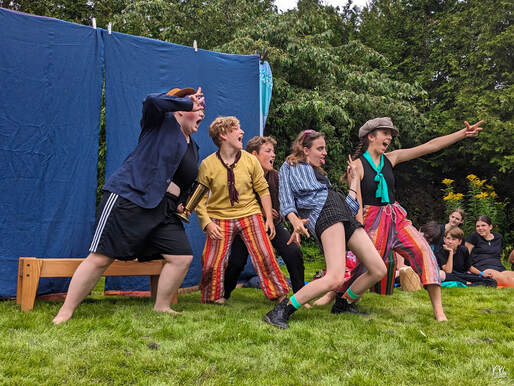
Each summer we bring young actors together in the gorgeous Green Mountain State. We create an intentional community of the arts. After two weeks we put on a production that we're proud to show to anyone in the world.
How do we do it? We get physical! With great warm-ups, voice training, and techniques passed on to us by amazing teachers, like Jacques LeCoq, Tony Montanaro, and Gould & Stearns, we get Shakespeare's language to leap right off the page. Our original "Vector Training" gets young actors speaking in a way they will never forget.
Why do we do it?
We think that Funnery training is so positive, it's the CURE for everything negative, cynical, depressing, scary, or commercial that threatens to colonize our bodies and brains.
We wish we could be together for the other fifty weeks of the year.
But we can't. So we make it last.
How do we do it? We get physical! With great warm-ups, voice training, and techniques passed on to us by amazing teachers, like Jacques LeCoq, Tony Montanaro, and Gould & Stearns, we get Shakespeare's language to leap right off the page. Our original "Vector Training" gets young actors speaking in a way they will never forget.
Why do we do it?
We think that Funnery training is so positive, it's the CURE for everything negative, cynical, depressing, scary, or commercial that threatens to colonize our bodies and brains.
We wish we could be together for the other fifty weeks of the year.
But we can't. So we make it last.
 |
 |
The Four
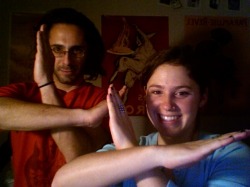
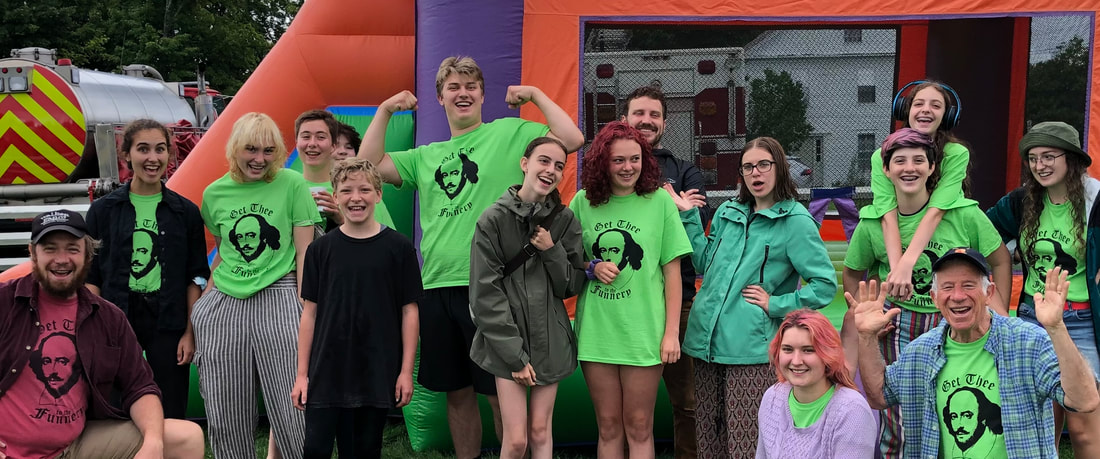
If you run into someone wearing a "Get Thee to the Funnery" T-shirt,
make the SIGN OF THE FOUR. It'll come right back at you.
1. HEART: We work on empathy: for each other, for the material, for our audience, our community, and for Shakespeare himself.
2. MIND: We help each other with every word in the play. We learn history, culture, and character. We discuss Shakespeare's relevance to the world of today. We calm our minds with meditation, too. We truly care about each other's mental health.
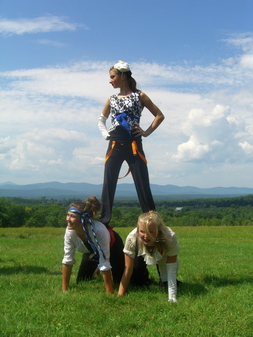
3. BODY: We physicalize as much as we can—not to subtract words from the text, but to clarify them.
We train with yoga, stretching, mime, dance, eclectic movement, and more!
4. VOICE: We learn about resonance and articulation, and we sing. We care enough about our audience that we want everyone to hear and understand! We explore what may be blocking our free and natural voice, and we work to get whatever is in our way OUT of the way.
You may hear about this "Sign of the Four" somewhere else. Remember: it all began at the Funnery!
make the SIGN OF THE FOUR. It'll come right back at you.
1. HEART: We work on empathy: for each other, for the material, for our audience, our community, and for Shakespeare himself.
2. MIND: We help each other with every word in the play. We learn history, culture, and character. We discuss Shakespeare's relevance to the world of today. We calm our minds with meditation, too. We truly care about each other's mental health.
3. BODY: We physicalize as much as we can—not to subtract words from the text, but to clarify them.
We train with yoga, stretching, mime, dance, eclectic movement, and more!
4. VOICE: We learn about resonance and articulation, and we sing. We care enough about our audience that we want everyone to hear and understand! We explore what may be blocking our free and natural voice, and we work to get whatever is in our way OUT of the way.
You may hear about this "Sign of the Four" somewhere else. Remember: it all began at the Funnery!
Our style
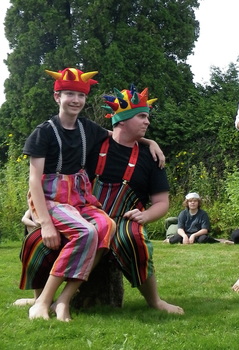
First we form a sprawling happy ensemble. We have no stars; we share roles. One summer, six different people played King Lear. Sometimes our urge to split a role brings unexpected dividends, like when we discovered that Trinculo in the Tempest could be a terrible ventriloquist!
Stephano: "How cam'st thou
to be the siege of this moon-calf? Can he ventTrinculos?" (Get it?)
We perform outside with the Vermont hills as our backdrop. Costumes and props: minimal. You can see all of us all of the time, watching the action, adding voices, being responsible for the whole play, not just the several scenes we are in.
Our campers come back for more every summer, so they'll have a chance to play young, old, any gender, comic, tragic, noble & lowly, by the time they're just too old to do camp any more. Then, if they're lucky, and we're lucky, too, they may join our staff!
Stephano: "How cam'st thou
to be the siege of this moon-calf? Can he ventTrinculos?" (Get it?)
We perform outside with the Vermont hills as our backdrop. Costumes and props: minimal. You can see all of us all of the time, watching the action, adding voices, being responsible for the whole play, not just the several scenes we are in.
Our campers come back for more every summer, so they'll have a chance to play young, old, any gender, comic, tragic, noble & lowly, by the time they're just too old to do camp any more. Then, if they're lucky, and we're lucky, too, they may join our staff!
SPECIAL TRAINING OPPORTUNITIES
SOMETIMES we hold special during-the-year TRAINING.
Like the one we did on ZOOM in 2021
with Thespo in India & Funnery in Vermont, available all over the globe. Doing in-person Funnery Training is the best way we know to
FREE UP YOUR NATURAL VOICE.
We're available to help you mount your own productions of Shakespeare.
We are everywhere. Or: we travel!
Please get in touch to find out how to nab us.
Like the one we did on ZOOM in 2021
with Thespo in India & Funnery in Vermont, available all over the globe. Doing in-person Funnery Training is the best way we know to
FREE UP YOUR NATURAL VOICE.
We're available to help you mount your own productions of Shakespeare.
We are everywhere. Or: we travel!
Please get in touch to find out how to nab us.
